IP Status: Granted European patent
Technology Area: Technical Ceramics / Advanced Materials / Ceramic Manufacturing Technologies
TRL: 6
A coagulation-based ceramic dough technology designed to simplify green machining of technical ceramics through room-temperature processing and lower machining-force requirements, offering the potential to reduce energy demand while enabling precise shaping before sintering.
Technology Overview
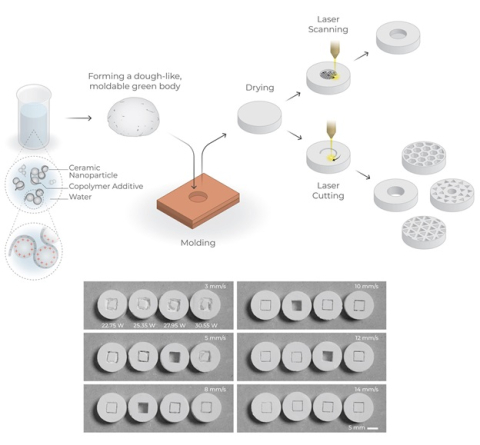
This technology introduces a coagulation-based ceramic dough formulation developed to facilitate green machining of technical ceramics before sintering. The formulation combines a linear copolymer based on acrylic acid (AA) and 2-acrylamido-2-methylpropane sulfonic acid (AMPS), water, and metal oxide ceramic nanoparticles at controlled concentrations. The technology can be applied to metal oxide ceramic systems including alumina, magnesium oxide, and yttria-stabilized zirconia.
The core mechanism relies on polymer bridging between ceramic nanoparticles to produce uniform coagulation. This structure provides the ceramic dough with sufficient elasticity and malleability despite its high ceramic content, enabling green bodies to be shaped and machined at room temperature. Processes such as milling, cutting, and laser cutting can therefore be performed before the ceramic component is sintered.
A key value proposition of the technology is the simplification of ceramic machining through lower-force, room-temperature processing. Green ceramic dough requires lower machining forces than fully sintered ceramic components, while the formulation can be processed without elevated temperature. Together, these characteristics create the potential to reduce process energy requirements while simplifying the manufacture of complex ceramic geometries.
The formulation also uses a relatively low concentration of copolymer while maintaining a high ceramic nanoparticle content. This reduces dependence on large quantities of organic binders, dispersants, and other processing additives. As a result, the need for complex binder-removal procedures during sintering can be reduced, helping simplify the overall manufacturing process.
Ceramic dough scraps generated during green machining can be reconditioned by adding water and reused in the process. This feature creates additional opportunities to improve material efficiency and reduce production waste.
Problem / Market Need
Fully sintered technical ceramics are highly hard and brittle, making final-stage machining difficult and potentially increasing machining forces, tool wear, cracking risk, and overall production costs. For complex ceramic components, shaping and machining the material before sintering can therefore provide significant manufacturing advantages.
Conventional approaches for producing machinable green ceramic bodies may require high levels of organic binders and processing additives, pressure-based forming equipment, specialised processing setups, or additional temperature-controlled stages. This technology addresses these limitations by providing a ceramic dough that can be shaped and machined at room temperature with low additive levels, simplifying green machining and offering the potential for lower process energy requirements.
Key Advantages
- Potentially lower process energy requirements through room-temperature green machining
- Lower machining-force requirements compared with machining fully sintered ceramic components
- Suitable for pre-sintering milling, cutting, and laser machining
- High ceramic nanoparticle content with relatively low copolymer concentration
- Reduced need for complex binder-removal procedures
- Reuse of machining scraps through the addition of water
- Applicable to alumina, zirconia, magnesium oxide, and other technical ceramic systems
- Ability to machine fine details and complex geometries in the green state
Applications
- Technical ceramic component manufacturing
- Green machining of ceramics
- Ceramic rapid prototyping
- Production of complex and high-precision ceramic geometries
- Alumina-based technical ceramics
- Zirconia and other metal oxide ceramic applications
- Ceramic shaping through milling and laser cutting
Relevant Industries
- Technical Ceramics
- Advanced Materials
- Precision Manufacturing
- Medical and Dental Technologies
- Energy Technologies
- Electronics and High-Temperature Applications
Technology Readiness Level & Validation
Technology Readiness Level: TRL 6
Laboratory prototypes have been developed and experimental studies have been completed using several technical ceramic materials, particularly alumina. These studies provide technical validation of the formulation’s shaping and green-machining capabilities, while the technology is currently progressing through industrial validation.
Intellectual Property
European Patent: EP4355712B1
Patent Title: Preparation of ceramic doughs through coagulation, for green machining
Priority Date: 18 June 2021
European Filing Date: 16 June 2022
Grant Publication Date: 2 October 2024
Applicant / Assignee: Sabancı University
Commercialisation Status
The technology is currently at the industrial validation stage and is available for licensing.
Collaboration Opportunities
- Licensing
- Scientific consultancy
- Joint R&D and co-development
- Industrial validation and pilot testing
- Joint production and manufacturing collaboration
Potential partners may include technical ceramic manufacturers, advanced materials companies, precision ceramic component producers, ceramic machining technology providers, and industrial companies using high-performance ceramic components.
Inventors
Inventors: Ozge Akbulut, Omid Akhlaghi Baghoojari, Lyn Zemberekci, Gizem Demir
Contact
For licensing, industrial validation, joint R&D, or other collaboration opportunities related to this technology, please contact Sabancı University Technology Transfer Office (SUATT) at dpe.suatt@sabanciuniv.edu.