Patent Title: Flow System for Avoiding Particle Agglomeration
IP Status: Granted European Patent (EP3365627B1); patent coverage in the United States and Türkiye
Technology Area: Nanotechnology, Microfluidics, Hydrodynamic Cavitation and Thermal Management
TRL: TRL 4
This hydrodynamic cavitation-based microfluidic system is designed to reduce nanoparticle agglomeration and maintain particle dispersion in nanofluids. Its reusable device architecture enables the physical processing of nanoparticle-containing liquids, offering a potential solution for improving nanofluid stability in advanced cooling, heat transfer and nanoparticle processing applications.
Technology Overview
Nanofluids are engineered liquids containing dispersed nanoparticles, offering opportunities for advanced heat transfer and fluid-based technologies. However, maintaining a stable nanoparticle distribution remains a challenge, particularly when fluids undergo repeated circulation or thermal cycling. Over time, nanoparticles may form larger agglomerates, affecting fluid stability and potentially compromising system performance. This microfluidic system addresses the challenge through a controlled physical deagglomeration process.
The technology uses hydrodynamic cavitation generated within specially designed flow-restrictive microchannels. As a nanofluid passes through a narrow flow section and undergoes sudden expansion, local pressure changes induce the formation of cavitation bubbles. The subsequent collapse of these bubbles produces localized physical effects that help break apart nanoparticle agglomerates and redistribute particles within the carrier liquid.
The system incorporates flow-restrictive elements with heating arrangements positioned near the cavitation region. Depending on the configuration, the design may include thin-film heaters, plasmonic materials and plasmonic near-field radiative heat transfer mechanisms. These features provide additional control over the thermal and flow conditions associated with cavitation and nanoparticle dispersion.
Unlike approaches that depend extensively on surfactants or chemical surface modifiers, the system primarily exploits physical effects associated with fluid flow and cavitation. This offers an alternative route to managing nanoparticle agglomeration while reducing reliance on additional chemical dispersants. Its reusable device architecture is particularly relevant to applications involving repeated processing or circulation of nanoparticle-containing liquids.
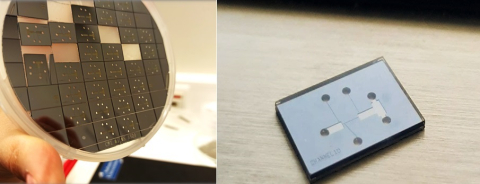
An initial prototype was fabricated using silicon-based microfabrication techniques and operated under laboratory conditions. The device architecture also offers potential for adaptation to alternative manufacturing approaches, including additive manufacturing and polymer-based fabrication. These options may support the development of application-specific devices with different operating requirements, flow capacities and geometries.
Problem / Market Need
Nanoparticle agglomeration is a significant technical barrier to the wider practical use of nanofluids. Repeated circulation, heating and changes in operating conditions can encourage nanoparticles to form larger clusters. This may reduce dispersion uniformity, affect heat transfer characteristics, obstruct narrow flow channels and contribute to particle deposition on internal system surfaces.
Conventional stabilisation strategies frequently involve surfactants or chemical surface treatments. Although these approaches can improve dispersion, additional chemicals may affect fluid properties or introduce formulation and processing considerations for particular applications.
There is therefore a technical need for approaches that can restore nanoparticle dispersion during fluid processing. This system addresses that need by using controlled cavitation to break up particle agglomerates, potentially supporting more consistent fluid characteristics during repeated operation.
Key Advantages
- Hydrodynamic nanoparticle deagglomeration: Uses the physical effects of cavitation bubble formation and collapse to disperse agglomerated nanoparticles.
- Reduced reliance on chemical dispersants: Provides a physical alternative to extensive surfactant-based stabilisation approaches.
- Support for nanofluid stability: Helps maintain nanoparticle dispersion by addressing the formation of larger particle clusters.
- Reusable device architecture: Enables nanoparticle-containing liquids to be processed through the device during repeated operation.
- Relevance to heat transfer applications: Supports the management of nanoparticle dispersion in fluids intended for thermal management systems.
- Compact microfluidic design: Uses flow-restrictive elements to generate cavitation under controlled flow conditions.
- Manufacturing adaptability: Offers opportunities to investigate additive manufacturing and polymer-based fabrication alongside established microfabrication methods.
Applications
- Nanofluid preparation and re-dispersion: Breaking up nanoparticle agglomerates and improving particle distribution in carrier liquids.
- Electronics cooling: Nanofluid-based thermal management and cooling configurations.
- Heat exchangers and thermal management: Applications where stable nanoparticle dispersion is relevant to heat transfer processes.
- Refrigeration and air conditioning: Cooling systems that incorporate nanoparticle-containing working fluids.
- Microreactors and microfluidic processes: Small-scale fluid systems requiring controlled nanoparticle distribution.
- Nanoparticle processing: Flow-based treatment and research applications involving particle deagglomeration.
Relevant Industries
- Nanotechnology and advanced materials
- Thermal management and heat transfer equipment
- Electronics and electronic cooling systems
- HVAC and refrigeration technologies
- Microfluidics and laboratory equipment
- Industrial fluid processing technologies
- Energy systems and advanced cooling applications
Technology Readiness Level & Validation
The technology is currently assessed at TRL 4. A physical prototype has been developed using silicon-based microfabrication methods and operated under laboratory conditions. The prototype provides a basis for evaluating nanoparticle deagglomeration through hydrodynamic cavitation.
Experimental investigations have examined changes in nanoparticle agglomerate size and the effects of cavitation within nanofluids. Dynamic light scattering (DLS) measurements provide technical data relevant to assessing nanoparticle agglomeration and the operating principle of the system.
Laboratory activities supporting the current technology readiness level have been completed, while additional testing and validation activities remain in progress. Further development may focus on evaluating performance under application-specific operating conditions and investigating alternative manufacturing approaches before wider industrial implementation.
Intellectual Property
The technology is protected by the granted European patent EP3365627B1. The corresponding patent family also includes the granted US patent US10837604B2. Patent coverage includes the United States and Türkiye.
Priority Date: 22 October 2015
European Patent Application: EP15823213.2
European Patent Grant Date: 10 July 2019
Patent Assignees: Sabancı University and Özyeğin University
Further technical and patent information is available through the EP3365627B1 patent record.
Commercialisation Status
The technology is at the prototype available stage and is available for licensing. Its laboratory-operated prototype provides a foundation for further technical validation, application-oriented development and potential technology transfer activities.
Future development opportunities include adapting the existing microfluidic architecture to alternative fabrication methods, optimising operating parameters for selected nanofluids and evaluating integration into industrial fluid processing or thermal management systems.
Collaboration Opportunities
Collaboration opportunities are available in licensing, scientific consultancy, joint R&D, co-development and industrial validation or pilot activities to support further development and application assessment of the technology.
Potential partners include nanofluid developers, microfluidic device manufacturers, thermal management technology providers and companies specialising in industrial fluid processing. Collaboration activities may focus on application-specific device design, nanoparticle dispersion assessment, fabrication development and performance validation under relevant operating conditions.
Inventors
- Ali Koşar
- Kürşad Şendur
- Mustafa Pınar Mengüç
Contact
For licensing, industrial validation, joint R&D or other collaboration opportunities related to this technology, please contact Sabancı University Technology Transfer Office (SUATT) at dpe.suatt@sabanciuniv.edu.