IP Status: Granted in DE, ES, TR
Technology Area: Automotive Engineering / Composite Materials / Vehicle Suspension
TRL: 5
A multi-stage composite leaf spring system designed to provide progressive suspension response under varying vehicle loads, while reducing unsprung mass and addressing friction, wear, and corrosion-related limitations associated with conventional metal leaf spring systems.
Technology Overview
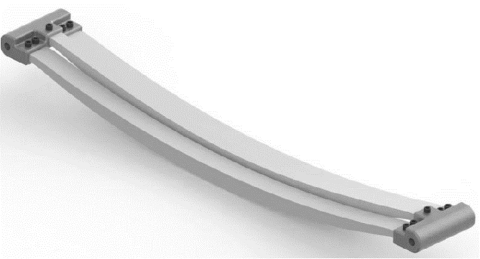
This technology introduces a multi-stage leaf spring system developed for vehicle suspension applications. Unlike conventional metal leaf spring configurations, the system employs multiple fiber-reinforced composite leaf springs with different stiffness characteristics working together. Rather than being stacked vertically, the spring elements are positioned substantially side by side, enabling different spring stages to engage in response to changing vehicle loads and road conditions.
The core concept is to provide a suspension system with a more adaptable mechanical response across different operating scenarios. As vehicle load or road input changes, different spring stages can become active, allowing the suspension to respond progressively rather than relying on a single fixed stiffness characteristic. This approach is intended to support more controlled suspension behaviour under varying loading conditions.
The use of fiber-reinforced composite materials also offers the potential for a lighter structure compared with conventional metallic leaf springs. In addition, the side-by-side arrangement is designed to reduce the contact, friction, and associated wear that can occur between vertically stacked spring elements. The system can be adapted through changes in spring geometry, dimensions, material properties, and stiffness according to the requirements of a specific vehicle platform.
The technology can be configured for a range of transportation applications, including passenger vehicles, light and heavy commercial vehicles, rail vehicles, and specialised defence platforms. Its combination of lightweight composite construction, progressive mechanical response, and configurable design makes it a promising solution for manufacturers developing advanced and application-specific suspension systems.
Problem / Market Need
Conventional metal leaf spring systems can contribute significantly to vehicle unsprung mass and may offer limited adaptability across changing load and road conditions. In traditional stacked leaf spring arrangements, contact between individual spring elements can also lead to friction and wear over time. Metallic components may additionally be affected by corrosion and other environmental conditions.
The patented system addresses these limitations through a multi-stage composite architecture in which springs with different stiffness characteristics engage progressively according to vehicle load and road input.
Key Advantages
- Potential reduction in unsprung mass through the use of fiber-reinforced composite leaf springs
- Progressive suspension response enabled by spring stages with different stiffness characteristics
- Reduced friction and wear associated with conventional vertically stacked leaf spring arrangements
- Potentially improved resistance to corrosion and environmental effects compared with metallic spring systems
- Modular architecture adaptable to different vehicle platforms and suspension requirements
- Spring geometry, material selection, and stiffness characteristics can be tailored to specific applications
Applications
- Passenger vehicle suspension systems
- Light commercial vehicles
- Heavy commercial vehicles and trucks
- Rail vehicle suspension systems
- Armoured personnel carriers and specialised vehicle platforms
Relevant Industries
- Automotive
- Commercial Vehicles
- Rail Transportation
- Defence Vehicles
- Composite Materials and Components
- Suspension System Manufacturing
Technology Readiness Level & Validation
Technology Readiness Level: TRL 5
A functional prototype of the multi-stage spring system has been developed and evaluated using a dedicated test fixture designed to replicate vehicle chassis conditions. The testing provided an initial validation of the system’s mechanical performance under representative loading scenarios, while full vehicle-level testing is planned as the next stage of development.
Intellectual Property
European Patent: EP4217215B1
Patent Title: A multi-stage spring system suitable for use in vehicles
Priority Date: 25 September 2020
European Filing Date: 24 September 2021
Grant Publication Date: 5 March 2025
Applicant / Assignee: Sabancı University
The patent family also includes international and national filings related to the same invention.
Commercialisation Status
The technology is currently at the industrial validation stage and is available for licensing.
Collaboration Opportunities
- Licensing
- Scientific consultancy
- Joint R&D and co-development
- Industrial validation and pilot testing
- Joint production and manufacturing collaboration
Potential partners may include vehicle manufacturers, suspension system suppliers, composite component manufacturers, and engineering companies working in vehicle dynamics, lightweight structures, and advanced suspension technologies.
Inventors
Inventors: Mehmet Yildiz, Erdal Kisa, Fatih Uzun
Contact
For licensing, industrial validation, joint R&D, or other collaboration opportunities related to this technology, please contact Sabancı University Technology Transfer Office (SUATT) at dpe.suatt@sabanciuniv.edu.